
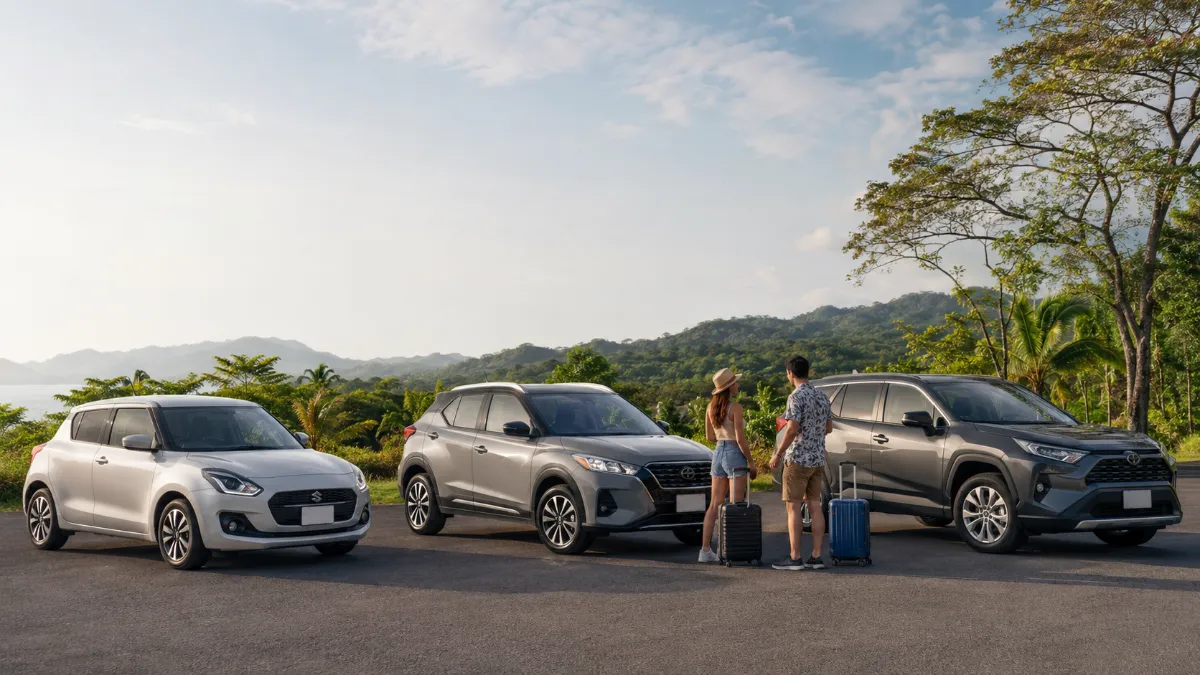
Costa Rica Rental Car Types: Vehicle Selection Guide
Official Alamo, National & Enterprise Partner. Zero risk, no credit card required online.



Costa Rica Rental Car Types: How to Choose the Right Vehicle
Costa Rica rental car types range from small economy cars and sedans to SUVs, 4x4s, pickups and passenger vans.
The right vehicle depends on your route, number of passengers, luggage and the final road leading to your accommodation.
A compact car can work very well for an itinerary that remains on paved roads, while higher ground clearance or four-wheel drive may be more useful for steep, rough, unpaved or remote access.
The best approach is to plan your route first and select the vehicle afterward.
Compare currently available vehicle categories for your dates after confirming your passenger needs, luggage and expected road conditions.
How to Choose a Rental Car in Costa Rica
Do not choose a rental vehicle based only on price, appearance or passenger-seat count.
Start with your itinerary.
Consider:
Number of travelers.
Number and size of suitcases.
Child seats or additional equipment.
Paved versus unpaved roads.
Mountain and rural driving.
Final hotel or villa access.
Ground-clearance requirements.
Whether four-wheel drive is recommended.
Automatic or manual transmission.
Length of the trip.
Two travelers staying on major paved tourism routes can have very different vehicle requirements from a family traveling to remote accommodations on unpaved roads.
Review the Costa Rica driving routes before deciding which category is appropriate.
Are Exact Rental Car Models Guaranteed?
Usually, travelers should not assume that the example vehicle shown for a rental category is guaranteed.
A listing such as Toyota Yaris or similar normally describes a rental category.
The actual vehicle supplied can vary according to rental brand, location, fleet and availability.
The alternative vehicle should belong to the applicable booked category according to the rental provider's terms, but its exact dimensions, luggage configuration and features can differ from the example model.
If a particular characteristic is essential to your trip, confirm the category specifications before booking.
Mini, Economy and Compact Rental Cars
Mini, economy and compact cars can be practical for solo travelers, couples and light packers whose itineraries remain primarily on paved roads.
Current Costa Rica fleets include categories represented by vehicles such as:
Toyota Agya or similar.
Suzuki Swift or similar.
Toyota Yaris or similar.
These categories can work well for cities, airport areas and established tourism corridors where additional ground clearance is not important.
Their main limitation is usually space rather than basic road usability.
A car described as accommodating four or five passengers may not comfortably carry the same number of people together with four or five large suitcases.
For this reason, always evaluate passengers and luggage together.
Mini, economy and compact cars are best suited to paved itineraries with light luggage and no special clearance requirements.
Midsize and Standard Sedans
Midsize and standard sedans provide additional cabin and luggage space while retaining the familiar driving characteristics of a conventional passenger car.
Current Costa Rica fleets include categories represented by models such as Toyota Corolla or similar.
This category can work well for couples, small families or groups of two to four travelers using primarily paved roads.
Sedans can be comfortable for longer highway trips, but they are not substitutes for vehicles with additional ground clearance or four-wheel drive when road conditions require those capabilities.
Before choosing a sedan for a remote lodge, rural vacation rental or beach property, confirm the final accommodation access road.
Compact SUVs and Crossovers
Compact SUVs and crossovers are popular because they combine manageable dimensions with increased cargo flexibility and, depending on the model, additional ground clearance.
Examples currently found in Costa Rica fleets include:
Nissan Kicks or similar.
Volkswagen T-Cross or similar.
Toyota Corolla Cross or similar.
They can work well for couples, families and travelers combining major highways with established tourism destinations.
However, an important distinction applies: an SUV is not automatically a 4x4.
Many SUV categories are two-wheel drive.
If four-wheel drive matters for your itinerary, verify that the booked category specifically states 4WD or 4x4.
Compact SUVs are particularly useful for travelers who want additional cargo flexibility or clearance without moving into a much larger vehicle.
Midsize and Standard 4x4 SUVs
A midsize or standard 4x4 can be useful when an itinerary combines normal highways with rough, steep or unpaved access roads.
Current categories may include vehicles represented by examples such as:
Suzuki Vitara or similar.
Toyota RAV4 or similar.
The key advantage is not simply the SUV body style. A category specifically identified as 4x4 provides four-wheel-drive capability in addition to the characteristics of the vehicle itself.
This can be useful where traction and road conditions justify it.
However, four-wheel drive has important limitations.
A 4x4 does not make flooded roads, deep water, uncertain river crossings, landslide areas, closed roads or prohibited routes automatically safe.
Check current road conditions rather than relying only on the capabilities of the vehicle.
Large and Premium SUVs
Large SUVs can suit families, longer road trips and travelers who need more passenger space.
Current fleets may include categories represented by vehicles such as:
Toyota Fortuner or similar.
Toyota Prado or similar.
Some large SUV categories can accommodate up to seven occupants.
However, seven seats do not necessarily mean enough luggage space for seven travelers.
When all seating rows are in use, cargo capacity behind the final row can be considerably reduced.
A family arriving with large checked luggage, carry-on bags, child equipment or sports gear should verify practical cargo capacity before selecting a vehicle based purely on the advertised seat count.
Large SUVs are useful for travelers who genuinely need additional passenger room, cargo flexibility or appropriate road capability.
Pickup Trucks
Pickup trucks can be useful when a trip involves bulky equipment or when a robust vehicle configuration is practical for the itinerary.
Current fleets can include categories represented by Toyota Hilux or similar.
Four-wheel-drive pickup categories may also be available.
A pickup is not automatically a better tourism vehicle than an SUV.
For ordinary sightseeing, consider passenger comfort, covered versus exposed cargo storage, rain protection, luggage security and vehicle dimensions.
If bags or equipment must travel in an open cargo bed, confirm how they can be protected from weather and secured appropriately.
Passenger Vans
Passenger vans can be practical for families and larger groups who would otherwise require multiple rental vehicles.
Current Costa Rica fleets can include van categories represented by examples such as:
Toyota Hiace or similar.
Hyundai H-1 or similar.
Comparable passenger vans.
Some fleets may also offer van categories with four-wheel-drive capability.
Passenger capacity alone should not determine the booking.
A van that can technically seat a large group may have significantly less luggage space when every seat is occupied.
Before booking, consider total passengers, large suitcases, carry-on luggage, child seats, surfboards or special equipment, final accommodation access and parking dimensions.
A larger vehicle can also be less convenient on narrow roads, tight hotel entrances or small parking areas.
Electric Rental Cars
Electric rental vehicles may be available from selected Costa Rica fleets and locations.
An EV can work well when charging fits naturally into the itinerary.
Before choosing an electric rental car, check:
Charging availability near accommodations.
Charging along longer routes.
Planned daily driving distances.
Time available for charging.
Charging compatibility and procedures.
Availability at the rental location.
Electric-vehicle practicality can vary considerably according to the exact route.
A trip between well-served destinations can present very different charging considerations from an itinerary involving remote areas.
Automatic or Manual Rental Car?
Both automatic and manual vehicle categories can appear in Costa Rica rental fleets.
Choose the transmission you are comfortable driving.
This is particularly important when dealing with hills, mountain roads, stop-and-go traffic, unfamiliar roads and longer driving days.
Do not assume the transmission solely from the example model shown in a category.
Similar models may appear in different fleet configurations.
If automatic transmission is important, select a category that explicitly indicates automatic transmission when booking.
2WD, High Clearance and 4x4 Are Not the Same Thing
These terms describe different vehicle characteristics.
2WD
A two-wheel-drive vehicle sends driving power to two wheels.
Many cars, crossovers and SUVs are 2WD.
High Ground Clearance
Ground clearance refers to the distance between the vehicle's underside and the road surface.
A vehicle can provide additional clearance while still being two-wheel drive.
4x4 or 4WD
A four-wheel-drive vehicle can supply driving power to all four wheels according to its system and operating configuration.
This can improve capability in certain steep, loose or uneven conditions.
However, 4x4 does not automatically mean the vehicle has unlimited clearance, specialized off-road tires or permission to drive on every surface.
Choose according to actual road requirements rather than the word “SUV” alone.
Do You Need a 4x4 in Costa Rica?
Not for every trip.
Many popular Costa Rica tourism routes use paved roads and can be traveled with conventional rental vehicles.
A 4x4 becomes more useful when the actual itinerary includes:
Steep unpaved roads.
Rough secondary roads.
Remote access.
Loose or irregular surfaces.
Accommodation access where four-wheel drive is specifically recommended.
The final few kilometers to an accommodation can matter more than the highway used for most of the trip.
Ask the hotel, villa or property about current road access before choosing the vehicle.
Review the Driving in Costa Rica guide for additional road and safety considerations.
How Much Luggage Fits in a Rental Car?
Luggage capacity varies substantially by category and actual vehicle supplied.
Do not calculate space from passenger seats alone.
A vehicle may technically accommodate five passengers but provide limited cargo room when every seat is occupied.
Consider:
Checked suitcases.
Carry-on bags.
Backpacks.
Strollers.
Child seats.
Golf equipment.
Surf gear.
Other oversized items.
If luggage capacity is important, choose conservatively.
Moving up one category can sometimes be more practical than trying to use every passenger seat and every available part of the cargo area.
Which Rental Car Type Is Best for Costa Rica?
There is no single best vehicle for every traveler.
A mini, economy or compact car is generally well suited to paved routes, solo travelers, couples and light luggage.
A midsize or standard sedan can provide more passenger and luggage space while remaining appropriate for paved-road itineraries.
A compact SUV can be useful when travelers want more cargo flexibility or additional clearance without choosing a large vehicle.
A 4x4 SUV is more appropriate when the itinerary includes confirmed rough, steep, unpaved or remote roads where four-wheel-drive capability is useful.
A large SUV can suit families or groups that need more cabin space, although cargo capacity should be checked carefully when all seats are occupied.
A pickup truck can make sense for specialized cargo requirements or bulky outdoor equipment.
A passenger van is generally the better choice for larger groups that want to stay together in one vehicle, provided luggage capacity has also been verified.
An electric vehicle can suit travelers whose route includes practical and reliable charging opportunities.
The goal should be to choose the smallest vehicle that comfortably handles your passengers, luggage and actual route.
Paying for additional size or four-wheel-drive capability that your itinerary does not require may provide little benefit. Choosing a vehicle that is too small can create luggage and comfort problems throughout the trip.
Rental Car Type by Trip Style
Couple on Paved Roads
An economy or compact vehicle may be sufficient when luggage is light and the itinerary follows established paved roads.
Couple With a More Varied Road Trip
A compact SUV can provide additional luggage flexibility and ground clearance without requiring a large vehicle.
Family of Four
Consider luggage before choosing solely by seat count.
A sedan, compact SUV or larger SUV may be appropriate depending on baggage and road conditions.
Five to Seven Travelers
A larger SUV or passenger van may be necessary, but cargo capacity should be verified when every seat is occupied.
Remote Accommodation
Ask the property about current road conditions before booking.
Higher clearance or four-wheel drive may be appropriate depending on the exact access road.
Surf or Adventure Trip
Consider equipment dimensions and whether a larger SUV, pickup, van or vehicle with suitable rack arrangements better fits the trip.
What Should You Check Before Booking a Vehicle?
Before selecting a Costa Rica rental car category, confirm:
Passenger count.
Number and size of bags.
Child-seat requirements.
Special luggage or equipment.
Automatic or manual transmission.
2WD or 4x4.
Ground clearance.
Main roads on the itinerary.
Final accommodation access.
Rental location.
Vehicle-category terms.
Current availability.
Also review applicable Costa Rica car rental insurance and rental requirements before completing the reservation.
Frequently Asked Questions
What type of rental car is best for Costa Rica?
There is no universally best category.
Choose according to passengers, luggage, main roads and final accommodation access.
A compact car may be ideal for a paved itinerary, while rough or steep roads may justify additional clearance or four-wheel drive.
Do I need an SUV in Costa Rica?
No.
A small car or sedan can work well for paved itineraries.
An SUV can become useful when you need additional cargo flexibility, ground clearance or a category specifically offering four-wheel drive.
Is every SUV in Costa Rica a 4x4?
No.
Costa Rica rental fleets include both two-wheel-drive SUVs and categories specifically identified as 4x4 or four-wheel drive.
Check the booked category rather than assuming four-wheel drive from the vehicle's appearance.
What is the best rental car for two people?
For two travelers with light luggage and a paved itinerary, an economy or compact vehicle may be sufficient.
A compact SUV can provide additional cargo flexibility and ground clearance when the itinerary is more varied.
What size rental car should a family choose?
Choose based on both passengers and luggage.
A five- or seven-seat vehicle can have limited cargo capacity when all seats are occupied, particularly when traveling with large suitcases, child equipment or special gear.
Do I need a 4x4 during Costa Rica's rainy season?
Not automatically.
Four-wheel drive can be useful when the itinerary includes steep, rough or unpaved access roads affected by wet conditions.
A rainy-season trip that remains on suitable paved roads does not automatically require a 4x4.
Is a compact SUV always better than a sedan?
No.
A compact SUV may offer additional clearance and cargo flexibility, but a sedan can be entirely suitable for a paved itinerary.
Choose according to actual trip requirements rather than vehicle style alone.
Are exact rental car models guaranteed?
Do not assume so.
Rental fleets commonly show an example model followed by “or similar,” indicating a vehicle category rather than a guarantee of the exact make and model.
The applicable booking terms determine the reserved category.
Can I request an automatic rental car?
Automatic categories are available in Costa Rica, but transmission depends on the category booked and current availability.
If automatic transmission is essential, reserve a category explicitly described as automatic.
Are passenger vans available in Costa Rica?
Passenger van categories are available from selected rental fleets and locations.
Confirm the number of seats, luggage capacity, transmission and road suitability before booking for a large group.
Can I rent an electric car in Costa Rica?
Electric rental vehicles may be available from selected fleets.
Before choosing one, verify charging opportunities along your actual itinerary and near the accommodations you plan to use.
Choose Your Costa Rica Rental Vehicle
The best rental vehicle for Costa Rica is the one that fits the trip you are actually taking.
Plan the route first.
Check the final road to each accommodation.
Count passengers and luggage together.
Determine whether additional clearance or four-wheel drive is genuinely useful.
Then compare available vehicle categories for your dates.
Explore car rental in Costa Rica and review current availability once your itinerary and vehicle requirements are clear.