
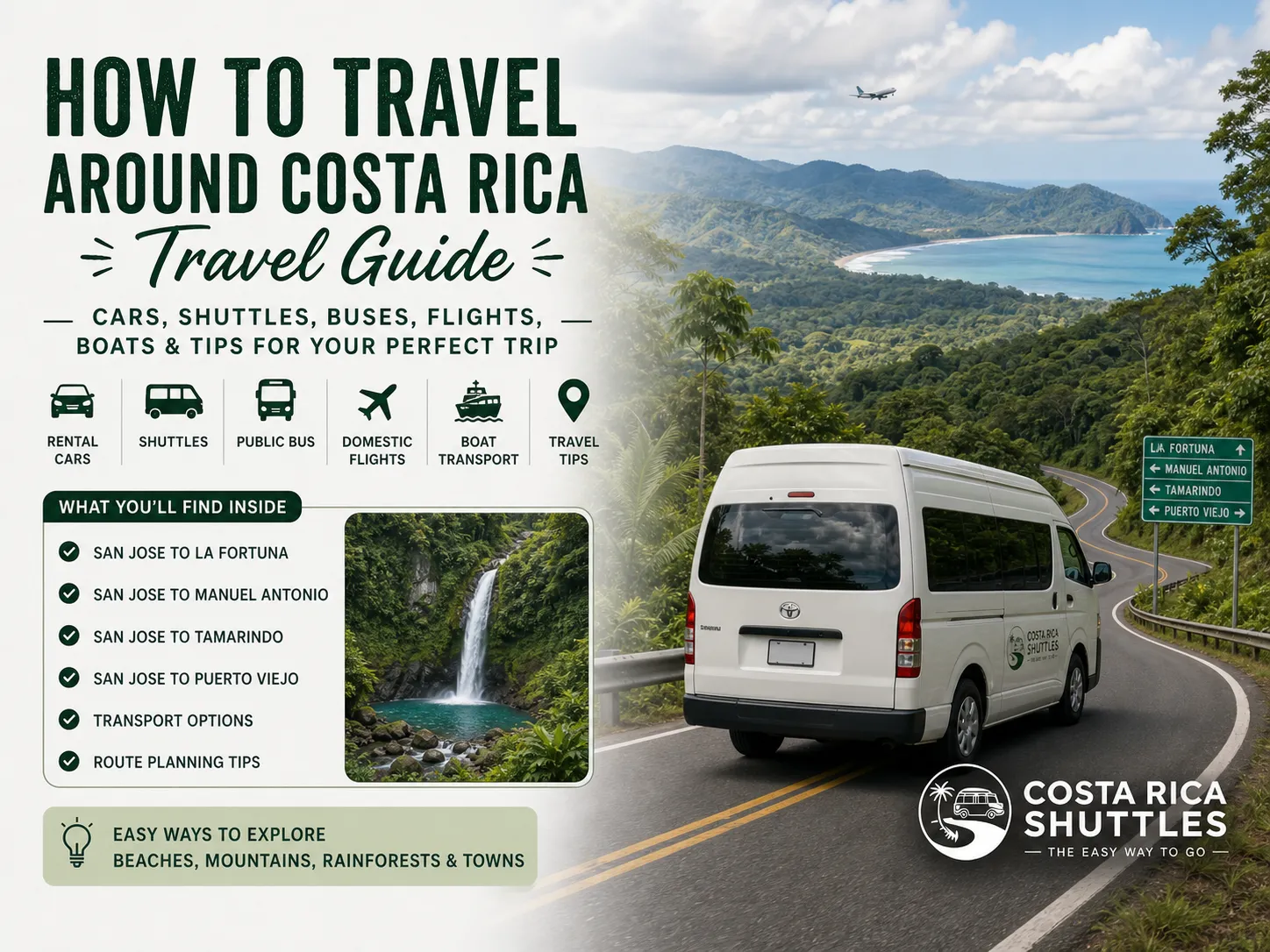
How to Travel Around Costa Rica
Plan how to travel around Costa Rica by combining private transportation, shared shuttles, rental cars, buses, domestic flights and boat connections.
How to Travel Around Costa Rica: Planning a Multi-Destination Trip
The most practical way to travel around Costa Rica depends on the itinerary rather than one transportation method.
A traveler visiting an airport, La Fortuna and a beach destination may need a different transportation strategy from someone planning several independent day trips or continuing to Tortuguero, Drake Bay or the Nicoya Peninsula.
Private transportation, shared shuttles, rental cars, public buses, domestic flights and boat connections can all form part of a Costa Rica trip. The key is deciding which transportation method fits each segment rather than assuming one option should cover the entire vacation.
Quick Answer
It depends on how many destinations you are visiting and how much independent mobility you need.
Use private transportation when you want an exclusive vehicle and greater control over departure planning.
Use a shared shuttle when an established route and scheduled departure match the itinerary.
Consider a rental car when you will use the vehicle repeatedly for independent exploration.
Public buses can fit travelers comfortable planning around local routes and connections, while domestic flights can reduce long overland portions of certain itineraries.
Boat or ferry transportation is necessary only for routes where a marine segment forms part of the journey.
Many Costa Rica trips work best by combining two or more methods.
Start With the Itinerary, Not the Transportation
Before choosing how to travel, list the trip in order.
For example:
Arrival airport → first destination → second destination → beach area → final hotel → departure airport
Then evaluate each segment individually.
Ask:
Where does this segment begin?
Where does it end?
How many passengers are traveling?
How much luggage is involved?
Do we need transportation at the destination?
Does a scheduled shuttle serve the route?
Would a rental car remain useful after arrival?
Does the journey require a ferry or boat?
Does a domestic flight meaningfully improve the complete journey?
Is the next segment connected to a flight or other time-sensitive reservation?
This approach prevents paying for flexibility you will not use or choosing scheduled transportation that does not fit the itinerary.
Do You Need One Transportation Method for the Entire Trip?
No.
A Costa Rica itinerary does not need to use the same transportation method from arrival until departure.
In many cases, mixing methods is more practical.
One trip might use:
Airport private transportation → shared shuttle → rental car → airport transfer
Another could use:
Rental car → hotel stay → vehicle return → private transportation
A remote itinerary might involve:
Ground transportation → boat → destination → return boat → private or shared transportation
The appropriate sequence depends on the actual destinations.
Private Transportation for Point-to-Point Travel
Private transportation can work well when the trip consists primarily of moving between airports, hotels and tourism destinations.
The vehicle is reserved for the confirmed travel party rather than combined with unrelated passengers.
Private transportation may fit when:
A scheduled shuttle does not match the itinerary.
Travelers want greater control over departure timing.
A family or group is traveling together.
The reservation includes significant luggage.
Transportation needs to coordinate with a flight.
The trip requires a direct point-to-point transfer.
Travelers prefer not to drive.
Pickup, drop-off, requested time, luggage and route availability still need to be confirmed.
Travelers ready to search specific routes can review the Private Transportation options.
Shared Shuttle for Scheduled Destination-to-Destination Travel
Shared transportation can work particularly well when the origin, destination and travel time already fit an established shuttle route.
Unlike private transportation, the passenger books a seat and shares the vehicle with travelers from other reservations.
This normally means:
Scheduled departures
Defined service areas
Possible additional passenger pickups
Possible additional drop-offs
Less departure flexibility
Shared luggage capacity
It can be a practical component of a multi-destination trip without requiring a rental car for the entire vacation.
Travelers should confirm exact pickup and drop-off arrangements because service to a destination does not automatically mean every hotel or vacation rental in the surrounding region is included.
Current scheduled connections can be reviewed through Shared Shuttle Services.
Rental Car for Independent Travel
Car rental becomes more useful when independent mobility adds value after reaching the destination.
It can fit an itinerary with:
Several destinations
Multiple independent day trips
Attractions away from town centers
Rural accommodations
Frequent local driving
Stops between overnight destinations
A rental car may add less value when it will remain parked while the traveler uses organized tours and only needs transportation between hotels.
You also do not necessarily need to collect the vehicle immediately after landing.
A mixed itinerary can use airport transportation first and begin the rental later when driving becomes useful.
Vehicle category, pickup, return, one-way availability, requirements, payment and protection terms should be reviewed for the actual reservation.
For detailed planning, use the Renting a Car in Costa Rica guide.
Public Bus Travel
Public buses can be part of a Costa Rica itinerary for travelers comfortable working with scheduled local transportation.
The practical questions are not simply whether a bus exists, but:
Where does it depart?
Does the journey require a transfer?
How does the traveler reach the terminal?
Where does the bus arrive relative to the accommodation?
How does luggage affect the trip?
Does the timetable work with the next reservation?
For some travelers, the additional connections are acceptable.
For others, the combined first-mile and last-mile transportation makes a shuttle, private transfer or rental car more suitable.
Public bus service should therefore be evaluated route by route rather than treated as one nationwide product.
Domestic Flights
Domestic flights can help reduce long ground-travel segments for certain itineraries.
However, compare the complete journey, not only the flight time.
A domestic-air itinerary can involve:
International airport or hotel → domestic airport → check-in → flight → regional airport → ground transportation → accommodation
Passengers also need to consider flight schedules, baggage conditions and connection time.
A flight may be an excellent fit when the complete journey is improved by flying, but it should not automatically be described as the fastest option for every long-distance route.
Ferries and Boat Connections
Some Costa Rica itineraries include a marine transportation segment.
This is not the same as choosing “boat transportation” as a general nationwide travel method.
A ferry or passenger boat becomes relevant when the specific route requires or benefits from it.
Examples of itinerary structures can include:
Ground transportation → ferry → ground transportation
or
Ground transportation → passenger boat → remote destination
The land and marine segments should be planned together when the connection is time-sensitive.
Never assume that because one route to a peninsula destination uses a ferry, every origin to the same destination must use that ferry.
How to Travel From the Airport
The first transportation decision often affects the rest of the trip.
International travelers commonly begin around Juan Santamaría International Airport (SJO) or Guanacaste Airport / Liberia International Airport (LIR).
Do not treat the airport and nearby city as interchangeable.
SJO and San José city can use different pickup arrangements, and LIR and Liberia city are also separate origins.
After landing, travelers might:
Take private transportation directly to the first destination.
Use a scheduled shared shuttle when the flight arrival fits the departure.
Collect a rental car.
Connect with a domestic flight.
Stay near the airport and continue the following day.
The appropriate strategy depends on arrival time and the next destination.
How to Plan a Three-Destination Trip
Consider a traveler visiting an airport, inland destination and beach destination.
The trip does not automatically require a rental car.
Strategy 1: Transportation Only
Airport → private or shared transportation → destination 1 → transportation → destination 2 → airport transportation
This can fit travelers who do not need independent mobility once they reach each destination.
Strategy 2: Rental Car Throughout
Airport or rental location → destination 1 → destination 2 → vehicle return
This can fit travelers who expect to use the car frequently throughout the trip.
Strategy 3: Mixed Transportation
Airport → private transportation → destination 1 → rental car → destination 2 → vehicle return → airport transfer
This can reduce the number of rental days while preserving independent driving during the portion where it adds value.
None of these structures is universally better.
Plan Around What Happens at Each Destination
A common planning mistake is focusing exclusively on transportation between destinations.
Also ask what happens after arrival.
If you stay four nights at a resort and every activity includes transportation, keeping a rental car parked may provide little additional value.
If you stay in a villa and plan independent visits to several beaches, restaurants and attractions, local mobility may be important.
This difference can determine whether rental car or organized transportation makes more sense.
Luggage Can Change the Transportation Plan
Passenger count alone is not enough.
Consider:
Number of suitcases
Large luggage
Surfboards
Bicycles
Strollers
Mobility equipment
Child seats
Other special items
Shared transportation has to accommodate luggage belonging to several reservations.
Rental vehicles have category-specific cargo capacity.
Private transportation also requires the appropriate vehicle to be assigned.
Provide unusual luggage information before booking any segment.
Travel Times in Costa Rica
Do not estimate Costa Rica travel exclusively from map distance.
Journey time can be influenced by:
Terrain
Traffic
Weather
Road conditions
Construction
Ferry coordination
Passenger pickups
Rest stops
Final accommodation access
A geographically short transfer can therefore require more time than expected.
Build each travel day around realistic route-specific estimates instead of using one nationwide rule.
Weather and Seasonal Planning
Transportation operates during different seasons, but weather affects individual routes differently.
Avoid using a simple formula such as:
Dry season = easy travel
Rainy season = difficult travel
A major paved corridor and a rural accommodation access road can behave very differently during the same week.
Check conditions relevant to the actual itinerary, particularly when driving or traveling to remote areas.
Should You Drive at Night?
There is no need to make a universal rule for every trip.
The better decision depends on the specific route, visibility, weather, driver experience, vehicle and arrival time.
Travelers uncomfortable driving unfamiliar roads after a long flight can use airport transportation and begin the rental portion later.
Avoid constructing an itinerary that depends on a demanding drive simply because the flight lands late.
Choosing Transportation by Traveler Type
Solo Traveler
Scheduled shared transportation may fit well when available, while public transportation can also form part of the itinerary.
Private service may become useful for routes without a suitable shared departure.
Couple
Couples can compare shared transportation, rental car and private transportation according to how often independent mobility will actually be used.
Family
Passenger count, child-seat needs, luggage and departure flexibility become more important.
Compare the complete cost and logistics rather than assuming one modality is always preferable.
Larger Group
Private transportation may simplify coordination when everyone shares the same itinerary, but vehicle capacity and luggage still require confirmation.
Road-Trip Traveler
A rental car may fit when independent exploration is a central part of the vacation.
The vehicle should be selected based on the real route rather than a generic assumption about Costa Rican roads.
When a Mixed Itinerary Makes Sense
Combining transportation modes can be especially useful when the character of the trip changes.
For example:
Arrival phase: private transportation after a long international flight.
Exploration phase: rental car for several independent destinations.
Remote phase: boat transportation where required.
Departure phase: shared or private airport transportation after returning the rental car.
This allows each transportation method to solve the problem it is actually designed for.
Compare Transportation Options in More Detail
This page focuses on building the itinerary rather than fully explaining every transportation product.
Travelers who want a deeper comparison of rental cars, private transfers, shared shuttles, buses, domestic flights, ferries and boats should use the Costa Rica Transportation Guide.
That guide can help compare the individual transportation methods after the overall trip structure is clear.
Frequently Asked Questions
What is the best way to travel around Costa Rica?
It depends on the itinerary. Private transportation, shared shuttles and rental cars solve different needs, and some trips work best by combining them.
Do I need a rental car in Costa Rica?
No. A rental car is particularly useful when you need independent mobility, but travelers can also build multi-destination trips around private transportation, shared shuttles, buses, flights and boat connections.
Is private transportation useful for traveling around Costa Rica?
Yes, when the required routes are available and travelers prefer an exclusive vehicle instead of driving or using scheduled shared transportation.
Can I travel around Costa Rica using shared shuttles?
You can use shared shuttles for routes and dates where scheduled service exists. Not every destination pair or accommodation is automatically covered.
Can I combine shuttles and rental cars?
Yes. A mixed itinerary can use transportation for some segments and a rental car for the portion where independent driving adds value.
Are domestic flights useful?
They can be useful for certain longer journeys, but compare the complete airport-to-hotel journey rather than flight time alone.
Do I need boats or ferries?
Only on itineraries where the route includes a relevant marine connection. Ferry and boat requirements depend on the exact origin and destination.
Does most travel begin in San José?
Not necessarily. Travelers may begin around SJO, LIR or another Costa Rica destination depending on their international arrival and itinerary.
Is traveling around Costa Rica easy?
It can be manageable with good planning, but geography, road conditions, schedules, ferry or boat connections and accommodation access can make some itineraries more complex than map distances suggest.
Build Your Transportation Plan
Start by putting every overnight destination in order.
Then decide which segments require an exclusive transfer, which fit a shared schedule and where having a rental car would genuinely add useful independence.
Include airports, ferry or boat connections, luggage, passenger count and final accommodation access before confirming reservations.
Costa Rica offers several ways to move between destinations. The most effective itinerary does not depend on choosing one transportation method—it comes from matching each segment with the transportation that fits that part of the trip.