
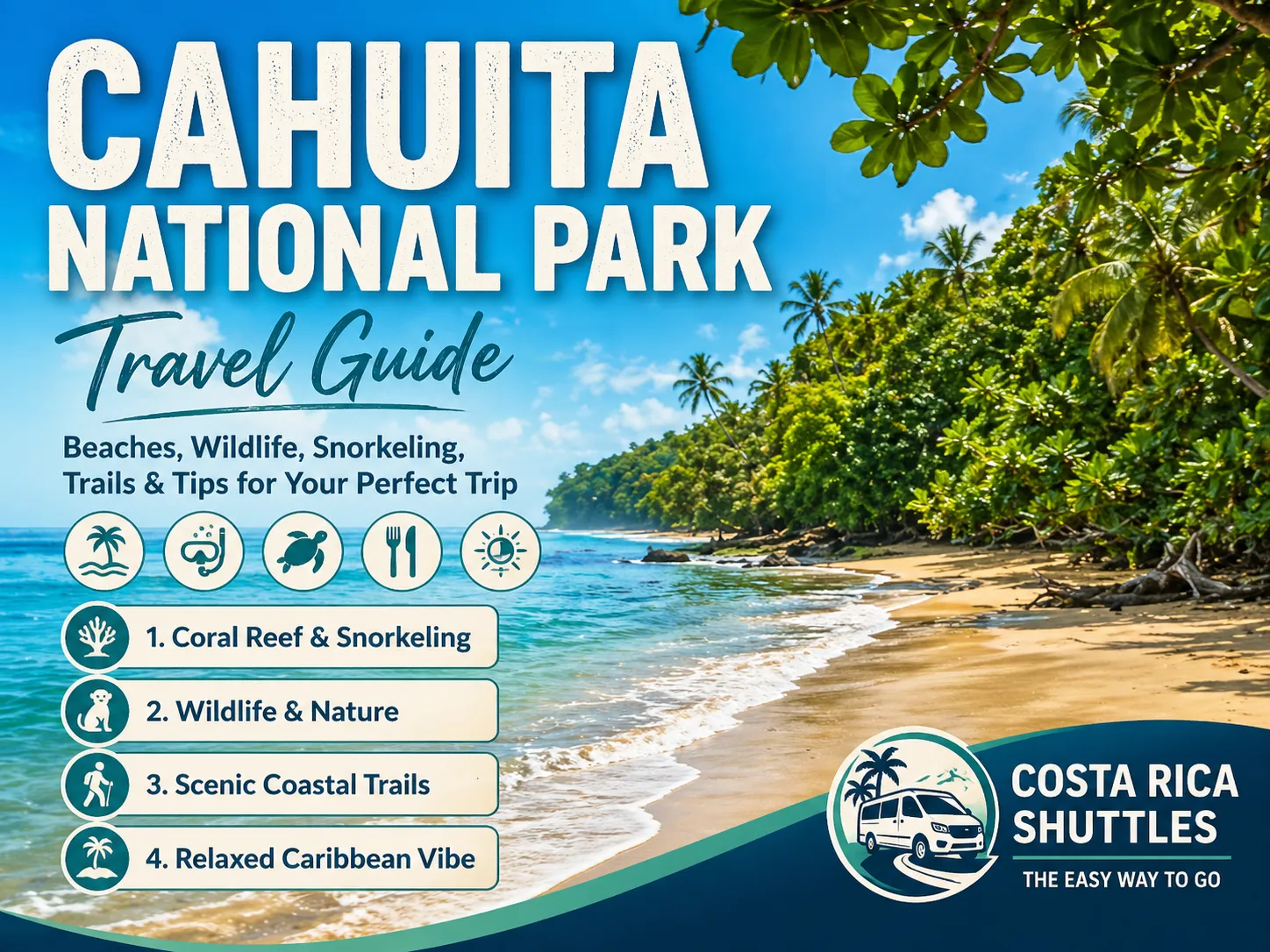
Cahuita National Park
A practical guide to Cahuita National Park covering beaches, rainforest trails, wildlife, snorkeling, weather, airport access, nearby destinations, and transportation.
Cahuita National Park Costa Rica: Complete Visitor and Transportation Guide
Why Visit Cahuita National Park Costa Rica?
Cahuita National Park Costa Rica combines Caribbean beaches, tropical rainforest, wildlife, coastal hiking, and an important coral reef within one protected area near the town of Cahuita in Limon Province.
The park is especially useful for travelers who want to experience Costa Rica nature without choosing between a beach day and a wildlife experience. Visitors can walk through forest beside the Caribbean Sea, look for monkeys and sloths, spend time on white-sand beaches, and explore designated marine areas when conditions allow.
Cahuita is also distinctive because of the close relationship between the national park and the local community. The park operates through a shared management model involving community representatives and Costa Rica's National System of Conservation Areas.
For travelers building a Caribbean itinerary, Cahuita National Park can be combined naturally with Cahuita town, Puerto Viejo, beaches farther south, and the Gandoca-Manzanillo area.
Where Is Cahuita National Park?
Cahuita National Park is on Costa Rica's southern Caribbean coast in Limon Province.
The park is directly associated with the town of Cahuita, making it relatively easy to combine a national park visit with accommodations, restaurants, and other activities in the surrounding community.
There are two principal visitor sectors: Playa Blanca, next to Cahuita town, and Puerto Vargas, located farther south. These access points provide different ways to experience the park and its coastal trails.
Travelers coming from San Jose generally reach the Caribbean side through the main road corridor toward Limon before continuing south toward Cahuita. Those staying in Puerto Viejo or other southern Caribbean destinations can include the park as part of a regional travel day.
What Makes Cahuita National Park Special?
Cahuita National Park protects both land and marine ecosystems.
The combination of tropical forest, coastline, beaches, and coral reef creates opportunities to see wildlife above and below the water. The protected marine environment includes one of the most developed coral reef systems on Costa Rica's Caribbean coast.
Unlike a national park where travelers mainly follow inland mountain trails, much of the Cahuita experience follows the coastline. Forest vegetation can extend close to the beach, allowing travelers to move between shaded trails and Caribbean coastal scenery.
The park is also closely connected with Cahuita's local culture and community. This makes the destination a good fit for travelers who want to combine nature with time in a smaller Caribbean town rather than visiting the park as an isolated attraction.
Beaches in Cahuita National Park
Beaches are a major part of visiting Cahuita National Park.
Playa Blanca is one of the best-known areas and can be reached from the entrance beside Cahuita town. Puerto Vargas provides another coastal environment within the protected area. Official park information describes white-sand beaches as one of Cahuita's principal attractions.
Visitors should remember that Caribbean sea conditions change. A beach that looks calm at one moment can experience different waves or currents later in the day.
Swimming decisions should therefore be based on the conditions present during the visit rather than assumptions about the beach.
Travelers should also respect protected areas, posted rules, wildlife, vegetation, and any instructions from park personnel or lifeguards.
Wildlife in Cahuita National Park
Wildlife viewing is one of the main reasons to visit Cahuita National Park Costa Rica.
Animals that may be encountered along the park's coastal forest include howler monkeys, white-faced monkeys, sloths, coatis, raccoons, iguanas, basilisks, toucans, and other tropical birds and reptiles. Wildlife sightings are never guaranteed because these animals live freely within a natural ecosystem.
Walking slowly and paying attention to the trees can make wildlife easier to notice. Monkeys and sloths are often easier to spot when visitors are not rushing along the trail.
A local guide can also help visitors identify animals, plants, sounds, and movement that are easy to miss without experience.
Wildlife should never be fed, touched, surrounded, or encouraged to approach for photographs. Visitors should also secure food and personal belongings because animals can become attracted to human food.
Hiking in Cahuita National Park
Hiking in Cahuita National Park is different from mountain hiking in many other parts of Costa Rica.
The experience is primarily coastal, with trails passing through tropical vegetation near beaches and marine environments. This allows travelers to combine walking, wildlife observation, photography, and beach time during the same visit.
The park includes trails accessible from both the Playa Blanca and Puerto Vargas sectors. Some sections also include accessibility improvements such as elevated walkways.
Visitors can explore independently, although SINAC recommends considering a trained local guide for travelers who want a more detailed wildlife and nature experience.
Comfortable walking shoes, drinking water, sun protection, insect repellent, and clothing suitable for humid tropical conditions are practical items to carry.
Snorkeling in Cahuita National Park
Snorkeling is one of the activities most strongly associated with Cahuita National Park.
The protected marine area contains coral formations and habitat for a variety of fish and other marine species. Designated areas are used for snorkeling when conditions and park regulations allow.
Sea conditions are an important factor. Visibility, waves, currents, rainfall, and wind can affect whether snorkeling is practical on a particular day.
Travelers interested specifically in snorkeling should avoid assuming that conditions will be suitable simply because they have scheduled a park visit.
Using a qualified local operator or guide can make planning easier, particularly for visitors unfamiliar with the reef and Caribbean ocean conditions.
Coral is extremely sensitive. Visitors should never stand on, touch, remove, or damage coral formations. Official park recommendations specifically instruct visitors not to stand on the coral.
Can You Visit Cahuita National Park Without a Guide?
Visitors can explore the terrestrial trails independently. However, travelers interested in wildlife identification, local ecology, and a deeper understanding of the park may benefit from hiring an accredited local guide. SINAC recommends local guiding as a way to improve the visitor experience.
A guide can be particularly useful when wildlife is difficult to spot. An experienced local guide may recognize animal calls, movement in the canopy, tracks, and other signs visitors might otherwise overlook.
Travelers mainly interested in a casual coastal walk and beach time may prefer to explore at their own pace.
Snorkeling should be considered separately because marine conditions, park regulations, and operating procedures may affect how reef activities are organized.
Playa Blanca or Puerto Vargas: Which Entrance Should You Use?
Cahuita National Park has access through the Playa Blanca and Puerto Vargas sectors.
Playa Blanca is directly associated with Cahuita town, making it convenient for travelers staying in or visiting the community.
Puerto Vargas is south of Cahuita and provides another access point to the protected area. Parking and visitor services are available in this sector.
The entrance that makes the most sense depends on where you are staying, how much of the trail you want to explore, transportation arrangements, and how you plan to organize the rest of the day.
Entrance procedures can differ between sectors and park policies may change. Travelers should verify current park rules before visiting rather than relying on older information about fees, schedules, or access procedures.
Best Time to Visit Cahuita National Park
Weather on Costa Rica's Caribbean coast follows a different pattern from popular Pacific destinations such as Tamarindo, Samara, or Manuel Antonio.
The Caribbean does not have the same sharply defined dry season found on much of the Pacific coast. Costa Rica tourism information identifies relatively drier periods around February and March and again around September and October, although rain remains possible throughout the year.
This means travelers should prepare for changing conditions regardless of the month.
Rain can influence trail conditions, wildlife activity, ocean visibility, snorkeling conditions, and road travel. A light rain layer and suitable footwear can be useful even when the morning begins with sunshine.
The best time to visit Cahuita National Park ultimately depends on the complete itinerary rather than one guaranteed weather window.
What to Bring to Cahuita National Park
Visitors should prepare for heat, humidity, tropical rain, beach conditions, and walking.
Comfortable clothing and footwear are useful for the trails. Sun protection and insect repellent are also important because much of the visit involves outdoor exposure.
Bring enough drinking water for the planned walking time, particularly if you intend to explore a substantial section of the park.
A small waterproof or water-resistant bag can be useful for protecting phones and personal items from unexpected rain.
Visitors planning beach time may also want swimwear and a towel. Those interested in snorkeling should confirm current arrangements before arriving rather than assuming equipment or access will be available in every situation.
Cahuita National Park With Kids
Cahuita National Park can work well for families because the visit can combine wildlife, walking, beaches, and nature observation without requiring a strenuous mountain hike.
Children may particularly enjoy looking for monkeys, sloths, birds, lizards, and other wildlife along the coastal forest.
Families should still prepare carefully for heat, humidity, insects, rain, and changing ocean conditions.
Parents should keep children close on the trails and around wildlife. Animals should not be approached or fed, and swimming should depend on current sea conditions and local guidance.
A private transportation service can also make the day easier for families because pickup and drop-off can be organized around the hotel and park visit.
Best Airport for Cahuita National Park
San Jose Airport, SJO, is generally the most practical major international airport for travelers whose itinerary includes Cahuita and Costa Rica's southern Caribbean coast.
From the Central Valley, travelers continue overland toward Limon and then south toward Cahuita. Official access information describes the approach from San Jose through Route 32 toward Limon before continuing toward Cahuita and Puerto Vargas.
Liberia Airport, LIR, serves Guanacaste and many northern Pacific destinations. It is generally less practical for a Caribbean-focused trip because it places travelers on the opposite side of the country.
Airport selection should still consider the complete vacation. A traveler combining Cahuita with La Fortuna, San Jose, or another region may have different transportation priorities from someone spending the entire trip on the Caribbean coast.
Transportation to Cahuita National Park Costa Rica
Transportation to Cahuita National Park Costa Rica should be planned around the traveler's starting point, accommodation, luggage, and complete Caribbean itinerary.
Travelers arriving through San Jose Airport can arrange private transportation directly toward Cahuita or combine an airport stay with transportation the following day.
Private transportation is particularly useful for families, groups, travelers with luggage, and visitors who prefer direct hotel pickup and door-to-door service.
Shared shuttle service may also be practical when scheduled departures match the traveler's hotel, destination, and timing.
Travelers already staying in Puerto Viejo or another southern Caribbean destination can arrange local or private transportation for a visit to Cahuita.
Costa Rica Shuttles can help organize private transportation, shared shuttle service, airport transfers, and long-distance transportation for travelers including Cahuita in a Costa Rica itinerary.
Cahuita National Park and Puerto Viejo
Cahuita and Puerto Viejo are easy destinations to consider within the same southern Caribbean itinerary.
Cahuita is particularly useful for travelers focused on the national park, wildlife, beaches, and a smaller Caribbean community.
Puerto Viejo provides another base for exploring the southern Caribbean coast and is commonly combined with beaches and destinations farther south.
Travelers do not necessarily need to choose between them. Staying in one destination and visiting the other can provide a broader experience of the region.
Those changing hotels can also use private transportation for direct door-to-door service between accommodations.
Nearby Destinations After Cahuita National Park
Puerto Viejo is one of the most natural destinations to combine with Cahuita.
Travelers continuing farther south can also explore the Caribbean communities and beaches toward Manzanillo and the Gandoca-Manzanillo area. Costa Rica tourism information groups Cahuita, Puerto Viejo, and Gandoca-Manzanillo as important destinations within the southern Caribbean tourism region.
Travelers returning inland can continue toward San Jose or combine the Caribbean with other Costa Rica travel regions.
Multi-destination trips require more transportation planning because crossing between the Caribbean, Central Valley, northern plains, and Pacific regions can involve substantial overland travel.
Planning the order of destinations before confirming every hotel can make the itinerary more efficient.
Private Transportation vs Shared Shuttle to Cahuita
Private transportation provides the greatest flexibility for travelers visiting Cahuita National Park.
A private transfer can be arranged around airport arrival times, hotel locations, group size, luggage, and the next destination. It is useful for travelers who want to move directly between San Jose Airport and the Caribbean or between hotels in different travel regions.
Shared shuttle service can be a practical option when scheduled departures match the traveler's itinerary.
The better choice depends on the number of passengers, pickup location, flight schedule, luggage, and whether Cahuita is the final destination or one stop in a longer trip.
For complex itineraries, private door-to-door transportation can reduce the number of separate connections required.
Cahuita National Park FAQs
Where is Cahuita National Park?
Cahuita National Park is on Costa Rica's southern Caribbean coast in Limon Province, next to the town of Cahuita.
What is Cahuita National Park known for?
The park is known for Caribbean beaches, tropical rainforest, wildlife, coastal trails, and an important protected coral reef system.
Can you see sloths in Cahuita National Park?
Sloths live within the park and may be seen along the forest trails. However, wildlife sightings are never guaranteed.
Are there monkeys in Cahuita National Park?
Yes. Howler monkeys and white-faced monkeys are among the wildlife found in the park.
Can you snorkel at Cahuita National Park?
Snorkeling is an established activity in designated marine areas of the park. Conditions and access can depend on weather, sea conditions, and current park procedures.
Do I need a guide for Cahuita National Park?
A guide is not necessary for independently walking the terrestrial trails, but a trained local guide can help visitors spot wildlife and understand the park's ecosystems.
How long should I spend at Cahuita National Park?
The amount of time depends on whether you want a shorter nature walk, extended hiking, beach time, wildlife viewing, or a marine activity. Travelers who want to combine several activities should allow a substantial part of the day rather than treating Cahuita as a quick roadside stop.
Is Cahuita National Park good for families?
Yes. Families can combine wildlife observation, relatively accessible coastal walking, and beach time. Parents should still consider heat, rain, insects, trail conditions, and ocean safety.
What is the best airport for Cahuita Costa Rica?
San Jose Airport is generally the most practical major international airport for travelers going to Cahuita and the southern Caribbean coast.
Can I visit Cahuita from Puerto Viejo?
Yes. Cahuita and Puerto Viejo can easily be included within the same southern Caribbean itinerary.
Can I arrange private transportation to Cahuita?
Yes. Private transportation can be used for airport transfers, hotel transfers, and transportation between Cahuita and other Costa Rica destinations.
Are shared shuttles available to Cahuita?
Shared shuttle service can be an option depending on the route, schedule, pickup location, and travel date.
Planning a Visit to Cahuita National Park Costa Rica
Cahuita National Park Costa Rica is a strong choice for travelers who want Caribbean beaches, rainforest, wildlife, hiking, and marine ecosystems within the same destination.
Its location beside Cahuita town also makes it practical to include in a longer southern Caribbean itinerary with Puerto Viejo and destinations farther south.
Visitors should plan for tropical weather, changing sea conditions, wildlife viewing, walking, and current park regulations. Travelers interested in snorkeling should also confirm marine conditions and activity arrangements for the day of their visit.
Transportation is another important part of the trip, especially when traveling from San Jose Airport or combining Cahuita with several Costa Rica destinations.
Costa Rica Shuttles can help organize private transportation, shared shuttle service, airport transfers, hotel pickup, and door-to-door transportation for travelers visiting Cahuita National Park and the southern Caribbean coast.